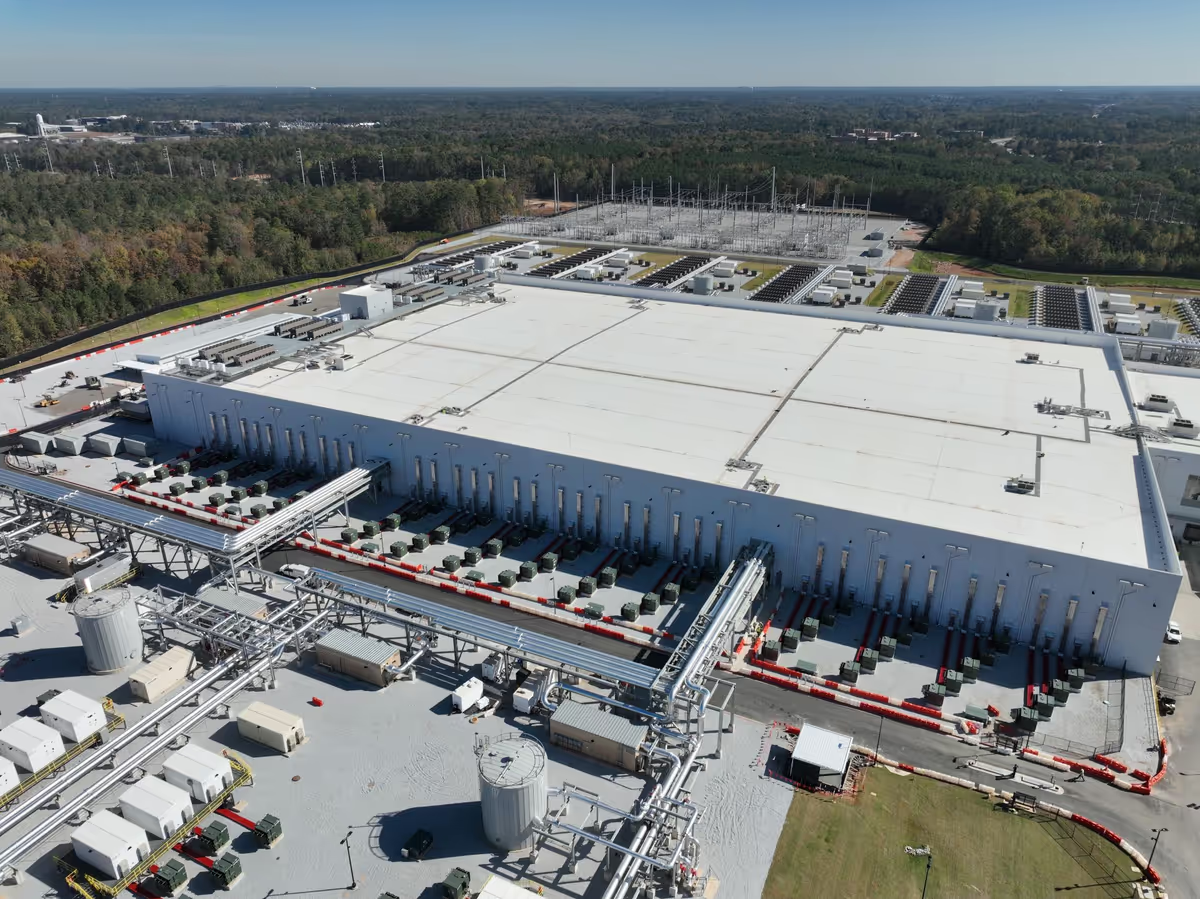
Every week a new headline announces another hundred billion dollars flowing into AI datacenters. Microsoft, Amazon, Google, and Meta have collectively pledged over $650 billion in capital expenditure for 2026 alone — more than the GDP of Sweden. Investors are simultaneously thrilled and terrified.
But most commentary misses the fundamental mechanics. How does a datacenter actually make money? Why is AI infrastructure so different from traditional cloud? And in the bear scenario nobody wants to discuss — who actually loses?
Let us walk you through the complete picture, from a single GPU server to the trillion-dollar industry.
How Traditional Cloud Works — The Proven Model
The Simple Version
Amazon Web Services, Microsoft Azure, and Google Cloud are, at their core, computing rental businesses. They build enormous physical facilities, fill them with servers, and charge businesses to use those servers by the hour. A company that used to run its own server room in the basement now pays AWS $0.025 per virtual CPU-hour instead.
This seems mundane but the economics are extraordinary.
What It Costs to Build
A traditional cloud datacenter — running standard Intel or AMD CPU servers — costs approximately $17 million per megawatt of capacity to build. The breakdown:
- Servers and hardware (CPUs): $8M (47%) — standard servers cost $2,000–5,000 each, you fit thousands per megawatt
- Electrical infrastructure: $3.8M (22%) — dedicated power substations, redundant feeds, UPS systems
- Land and civil construction: $2.5M (15%) — the building itself
- Cooling: $1.2M (7%) — air cooling is sufficient; standard HVAC at scale
- Networking: $0.8M (5%)
- Security and miscellaneous: $0.7M (4%)
The crucial characteristic of traditional cloud hardware: it is multi-tenant friendly. A single physical server can be sliced into dozens of virtual machines, each serving a different customer simultaneously. This keeps utilization high and unit economics excellent.
What It Earns
At 80% utilization — realistic for a mature cloud facility — a 1 MW traditional datacenter generates roughly $11.1 million in annual revenue. Against $6.5 million in annual costs (depreciation, electricity, labor, networking), that produces $4.6 million in operating income — a ~41% infrastructure margin.
The payback period on a $17M investment at $4.6M/year is ~3.7 years. At a 10-year datacenter life, you've generated ~$29M in profit on a $17M investment. Excellent business.
Where the Real Margins Live
But raw infrastructure is not where hyperscalers make their best money. On top of physical compute, they layer managed services — pre-packaged software that customers consume via API without managing any infrastructure themselves. Think Amazon RDS (managed database), AWS Lambda (serverless computing), or Azure Active Directory (identity management).
These managed services carry 65–75% gross margins because the hardware cost is shared across thousands of customers and the incremental cost of serving one more customer is nearly zero. When you add enterprise software on top — Microsoft 365, productivity suites, compliance tools — margins reach 75–88%. Pure software, no hardware cost.
This three-layer structure is the key to understanding hyperscaler economics:
| Layer | Gross Margin | Examples |
|---|---|---|
| Raw infrastructure | 7–26% | CPU-hours, storage TB, data transfer |
| Managed services | 50–75% | Databases, analytics, security tools |
| Enterprise software | 75–88% | Microsoft 365, Google Workspace |
AWS operates at ~40% overall operating margin. Microsoft Azure runs at ~42%. These are among the most profitable businesses ever constructed, precisely because the software layer transforms modestly profitable infrastructure into a machine that generates tens of billions in annual cash flow.
How AI Cloud Works — Same Building, Different Universe
The Fundamental Shift
AI workloads don't run on standard CPUs. They require GPUs — Graphics Processing Units originally designed for rendering video games, now repurposed as the engines of machine learning. And this single hardware difference transforms every economic assumption.
What an AI Datacenter Costs
An AI-optimized datacenter costs approximately $47.3 million per megawatt — 2.8 times more than traditional cloud. The cost explosion comes almost entirely from hardware:
- GPU servers: $35M (74%) — an NVIDIA H100 GPU costs $30,000–40,000 per chip. A single DGX H100 server with 8 GPUs costs ~$400,000. At 60 servers per megawatt, you've spent $24 million on servers alone before a single cable is run
- Electrical infrastructure: $5.2M (11%) — GPUs draw 300–700 watts each, requiring power delivery systems that handle 50–100 kW per rack versus 7–10 kW for traditional cloud
- Liquid cooling: $2.1M (4%) — mandatory. Air cooling simply cannot remove heat generated by GPU clusters. Direct-to-chip liquid cooling is required, adding cost and complexity
- Networking: $1.2M (3%) — ultra-high-speed InfiniBand interconnects required to link thousands of GPUs for parallel training
- Land and civil construction: $2.8M (6%)
The result is a facility that looks similar from the outside but operates at completely different physical parameters: 5–10 times the power density, 3–4 times the cooling requirements, and hardware that costs ten times as much per unit.
What It Earns — The Uncomfortable Truth
At 75% GPU utilization, a 1 MW AI datacenter generates roughly $15 million in annual revenue at average pricing of ~$5/hour per H100 GPU.
But the costs are brutal:
- Hardware depreciation: $11.8M/year ($47.3M ÷ 4 years — GPUs become obsolete in 3–4 years, not 5–7 like CPUs)
- Electricity: $3.2M/year (3x higher than traditional cloud)
- Labor and maintenance: $1.8M
- Networking and security: $0.9M
- Total costs: $17.7M
Operating income: −$2.7 million. A loss.
This is the number that most AI infrastructure commentary glosses over. Raw AI infrastructure — renting GPU hours to whoever wants them — is structurally unprofitable. The depreciation cost alone exceeds total gross profit. Every company that only rents GPUs — the so-called "neoclouds" like CoreWeave or Lambda Labs — operates at approximately 3% gross margin. They are essentially utilities running on the edge of viability.
Why Hyperscalers Build It Anyway
If AI infrastructure loses money at the facility level, why are Microsoft and Amazon spending hundreds of billions on it?
Because the infrastructure is not the product. The infrastructure is the cost of entry to sell something far more valuable.
When Microsoft offers Azure OpenAI Service — a managed platform that lets any enterprise call GPT-4o or Claude via API without managing a single server — it charges based on tokens processed, not GPU hours consumed. The pricing obscures the underlying hardware cost completely. At $0.08 per million tokens, Microsoft's infrastructure cost is roughly $0.02 per million tokens, yielding a 68% gross margin on the exact same hardware that was losing money as raw GPU rental.
Stack on top of that an enterprise software subscription — Copilot embedded in Microsoft 365 at $25 per user per month, where the AI inference cost is maybe $2.50 — and the margin reaches 88%.
The formula is: Build infrastructure at a loss. Wrap it in software. Sell the software at extraordinary margins.
The Custom Silicon Revolution
The most important long-term development in cloud economics is one that rarely gets covered in mainstream financial media: hyperscalers are building their own AI chips to escape NVIDIA's pricing.
An NVIDIA H100 GPU costs $30,000–40,000. That price includes NVIDIA's ~60% gross margin embedded in every chip. When AWS, Google, and Microsoft buy hundreds of thousands of these chips, they are collectively transferring tens of billions of dollars per year to Santa Clara.
The solution: design your own chips, have TSMC manufacture them, and capture that margin yourself.
- Amazon Trainium3: Built on TSMC's 3nm process. Delivers 50% lower cost per AI workload versus H100-class instances. Anthropic has validated production cost savings at scale
- Google TPU Ironwood: Priced at ~$2.70/chip-hour versus NVIDIA B200's ~$5.50/GPU-hour. Google plans to deploy over 5 million TPUs by 2027
- Microsoft Maia 200: Deployed in January 2026, already powering Copilot and Azure OpenAI services. Claims 30% better performance per dollar versus competing accelerators
When these chips reach full scale — expected 2027–2028 — they flip the AI infrastructure economics entirely. Hardware costs per MW drop from $35M to roughly $17.5M. Depreciation falls from $11.8M/year to $5.9M/year. That loss-making infrastructure layer becomes profitable at 21% operating margin — approaching traditional cloud levels. Combined with the managed services layer, blended operating margins converge toward 45–55% — potentially exceeding today's traditional cloud margins.
This is why custom silicon is arguably the single most important variable in every hyperscaler financial model through 2030.
Who Are the Customers, and What Have They Committed?
Understanding the risk profile requires understanding the contractual chain clearly. There are two completely separate commitment structures that are routinely conflated:
Layer 1 — Datacenter Developer → Hyperscaler
Companies like Digital Realty or Equinix build physical campuses and lease the buildings to Microsoft or Amazon under 15–20 year triple-net leases. Microsoft is the tenant. Microsoft pays monthly regardless of whether the building is full of GPUs or empty. Approximately 96% of new hyperscale datacenter capacity in mature markets is pre-committed before construction begins — meaning hyperscalers have signed legally binding obligations to pay for facilities that haven't been built yet.
Layer 2 — Hyperscaler → Enterprise/AI Labs
Cloud customers like OpenAI, Goldman Sachs, or a manufacturing company sign 1–3 year committed spend agreements with Microsoft or AWS, committing to a minimum annual spend in exchange for volume discounts of 40–70%. These are "pay or pay" contracts — if OpenAI commits to $10M/year on Azure GPUs and uses only half, it still owes $10M.
The combined committed cloud backlog across AWS, Azure, and Google Cloud reached $469 billion in mid-2025 — nearly half a trillion dollars of contractually locked future revenue.
The risk distribution from this structure:
| Layer | Risk Exposure |
|---|---|
| Datacenter developer | Minimal — 15–20 year lease with hyperscaler regardless of utilization |
| Hyperscaler (Microsoft, Amazon) | Medium-term — protected by 1–3 year customer commits, exposed when they expire |
| Enterprise customer | Short-term — must honor 1–3 year committed spend even if unused |
| AI lab (OpenAI, Anthropic) | Highest — pure demand risk, no guaranteed revenue |
The Bull Case — Why This Works
The bull thesis rests on five compounding forces:
1. Demand is real and accelerating
Microsoft Azure's AI revenue grew 175% year-over-year. Amazon's cloud backlog is at all-time highs. These are not speculative forward projections — they are revenues already being collected from committed customers. Andy Jassy has stated explicitly: "We don't procure infrastructure unless we see significant signals of demand."
2. Enterprise AI is still below 10% penetration
The vast majority of global enterprise workflows have not yet been touched by AI. Every percentage point of penetration adds billions in incremental compute demand. The hyperscalers are building toll roads before the traffic arrives — and the traffic is verifiably coming.
3. Jevons Paradox compounds the opportunity
As AI inference costs fall — from ~$30 per million tokens in 2023 toward $0.50–1.00 by 2028 — usage volumes explode. When electricity was expensive, people conserved it. When it became cheap, consumption multiplied tenfold. The same dynamic applies to AI compute: cheaper inference unlocks applications that don't exist today, expanding the market faster than prices decline.
4. Custom silicon unlocks margin expansion
By 2028, Trainium, Maia, and TPU v7 collectively eliminate the structural loss at the infrastructure layer. Infrastructure becomes modestly profitable on its own. Managed services margins expand as hardware costs fall. The entire P&L structure improves simultaneously.
5. Pre-committed revenue de-risks the transition period
$469 billion in committed cloud spend provides a 2–3 year revenue bridge while the industry transitions from investment mode to monetization mode. Even if AI revenue growth disappointed for two full years, existing commitments would sustain margins near current levels.
Bull case outcome (2030+): AWS at 45–50% operating margin, Azure at 47–55%, Google Cloud at 43–50%. Combined hyperscaler AI operating income: $400–600 billion annually.
The Bear Case — The Scenario Nobody Models Properly
The bear case is not that hyperscalers lose money. It is more nuanced — and more dangerous in specific pockets of the ecosystem.
Risk 1 — Model Commoditization
In early 2025, Chinese lab DeepSeek trained a frontier-class AI model for approximately $6 million — versus the $100M+ estimated for GPT-4. If AI model capabilities commoditize rapidly, the "scarcity value" of compute disappears. Enterprises won't pay $0.08/million tokens if a comparable model is available for $0.005. Pricing power collapses. Managed service margins compress from 68% toward raw infrastructure levels.
Risk 2 — The Depreciation Wave (2027–2028)
Infrastructure built in 2025–2026 enters peak depreciation in 2027–2028. Even if revenue grows strongly, reported net income and EPS get compressed as billions in depreciation charges hit the income statement. These companies could be genuinely performing well operationally while reporting earnings that look poor — creating a valuation trap for momentum investors who don't model depreciation carefully.
Risk 3 — Committed Spend Expires Unrenewed
The $469 billion backlog is not permanent. It represents 1–3 year commitments signed in 2023–2025. If AI demand disappoints by 2026–2027, enterprises simply don't renew. Revenue falls off a cliff precisely as the depreciation wave hits — a double squeeze on margins that could compress AWS and Azure operating margins to 30–35%.
Risk 4 — The Neocloud Squeeze
CoreWeave, Lambda Labs, and emerging GPU clouds undercut hyperscaler AI pricing by 40–85% on raw compute. As enterprises become sophisticated enough to separate infrastructure from managed services — running their own models on cheaper neocloud hardware and only consuming hyperscaler APIs for enterprise integration — the infrastructure revenue base erodes.
Risk 5 — Physical Constraints Create Cost Overruns
AI datacenters consume so much electricity that hyperscalers are now competing for power grid access, substation permits, and water rights. These are not problems money alone solves quickly. Construction overruns, permitting delays, and energy cost inflation could push the industry-wide breakeven from 2032 to 2035.
Bear case outcome: Margins plateau at 33–38% through 2029. Neocloud sector suffers mass consolidation. Speculative datacenter REITs built without committed tenants face severe distress. Hyperscalers survive comfortably but miss margin expansion targets — stocks that priced in 50%+ margins re-rate lower.
What Actually Breaks in the Bear Case
The critical distinction is between who gets hurt and who gets destroyed.
Gets hurt: Microsoft, Amazon, Google — margin compression, CapEx write-downs, disappointing EPS growth. Painful but survivable. Their diversified businesses (consumer software, e-commerce, search, enterprise productivity) provide enormous cushions.
Gets destroyed: Speculative datacenter developers who built on expected-but-not-committed hyperscaler demand. Neoclouds without managed service revenue. Companies that financed GPU purchases with debt at 2024–2025 prices expecting 2026 AI revenue growth to materialize on schedule.
The hardware question: The GPU hardware that hyperscalers own can be partially repurposed — scientific computing, pharmaceutical research, rendering, financial simulation. But a GPU running a web server workload is 40x more expensive than a CPU doing the same job. Much of the AI-specific investment becomes genuinely stranded in a bear scenario.
The real estate question: The 15–20 year building leases that hyperscalers signed cannot be easily exited. Break fees are equivalent to several years of remaining rent. In a severe bear scenario, hyperscalers would be paying for enormous power-dense facilities filled with underutilized GPUs for a decade — a structural drag on free cash flow even as earnings recover.
The Bottom Line
Here is what we believe, having thought and researched through this deeply:
The AI infrastructure buildout is not a bubble in the traditional sense. The demand is real, the contracts are signed, and the technology advantage of whoever controls the compute layer of the AI economy is genuine and durable. We do now know how big it will really be, but AI is here to stay and we are only at the beginning of its development. Hyperscalers will probably make substantial money — the question is when, and how much.
The real profits will probably never come from renting GPU hours. They will come from the software and managed services layer that transforms loss-making infrastructure into a platform business earning 60–80% gross margins. Custom silicon will close the remaining gap at the infrastructure level by 2028. The depreciation wave will create a window of disappointing reported earnings in 2027–2028 that represents opportunity, not crisis, for long-term investors who understand the mechanics.
The entities to be cautious about are not Microsoft or Amazon. They are the speculative developers, the pure-play GPU rental companies, and any business model predicated entirely on AI infrastructure demand materializing on schedule with no contingency.
The hyperscalers built the roads. The traffic is coming. The only real question is whether the tolls will be high enough to justify the construction cost.
Based on everything we can observe today, they probably will be. However, to be on the safe side, if you are considering investing in any of the hyperscalers (Microsoft, Amazon, Google, Meta, etc.) we suggest applying a wide margin of safety. If you want our own take on these companies, please consider signing up to find out more.
This analysis draws on company filings, Goldman Sachs research, McKinsey infrastructure analysis, and Futurum Research CapEx forecasts. All margin estimates represent industry consensus ranges and should not be taken as investment advice.